

You’ve finally landed that high-stakes interview or a dream client call. You double-check your calendar, set your alarm, and sit down at your desk with a fresh cup of coffee. Ten minutes pass. Then twenty. You check your email, heart sinking, only to see a “Where are you?” message sent an hour ago.
The culprit? That pesky one-hour gap between CST vs EST. It’s the silent productivity killer of the modern remote workforce. Whether you are a freelancer, a corporate manager, or just trying to catch a live game, getting these three letters mixed up feels like a personal failure. But it isn’t your fault—North American time zones are a patchwork of shifting borders and seasonal changes that would confuse a cartographer. This guide is here to ensure you never have to send an “I’m so sorry, I mixed up the times” email ever again.
What is the Difference Between CST and EST?
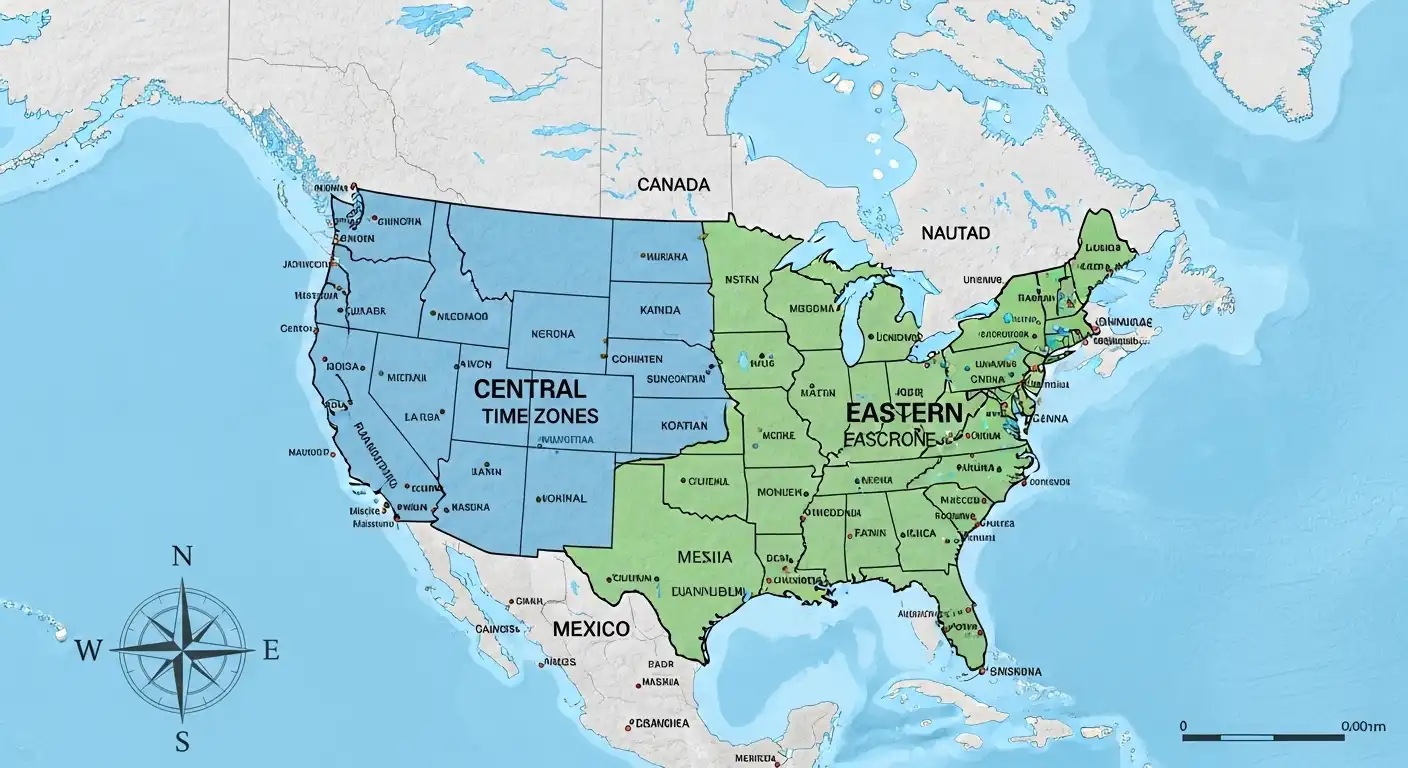
In the simplest terms, EST (Eastern Standard Time) is one hour ahead of CST (Central Standard Time). If it is 12:00 PM in Chicago (Central), it is already 1:00 PM in New York City (Eastern).
Think of North America as a relay race where the sun hits the Atlantic Coast first. As the earth rotates, the light “moves” West. Because the sun reaches the East Coast earlier, their clocks are set ahead to match the daylight. By the time the sun is directly overhead in the Central states, the East Coast has already finished their lunch break.
-
EST (Eastern Standard Time): UTC -5
-
CST (Central Standard Time): UTC -6
The “UTC” stands for Coordinated Universal Time. It is the primary time standard by which the world regulates clocks. The fact that EST is -5 and CST is -6 is the mathematical proof that EST is always the “later” time on the clock face.
The CST vs EST Gap in Real Life: A Tuesday Morning Crisis
To understand how this impacts your day, let’s look at “The Case of the Missing Freelancer.”
Imagine Sarah, a graphic designer in Austin, Texas (CST). She has a project hand-off meeting with a creative agency in Miami, Florida (EST). The agency sends an invite for 9:00 AM.
Sarah sees “9:00 AM” and assumes it’s her local time. She wakes up at 7:30 AM, takes her dog for a walk, and sits down at 8:55 AM. Meanwhile, in Miami, it is already 9:55 AM. Her clients have been sitting in the Zoom room for nearly an hour. They eventually leave, assuming Sarah is unprofessional or unreliable.
The Golden Rule: Always identify the “Anchor Zone.” If you are the one receiving the invite, immediately convert it to your local time. If the invite says 9:00 AM EST, Sarah needs to put 8:00 AM CST on her sticky note.
How to Calculate the Time Difference Step-by-Step
Calculating the shift between CST vs EST doesn’t require a degree in physics, but it does require a consistent system. Follow these steps to stay synchronized:
-
Identify the Source Time: Determine which time zone the meeting “belongs” to. Is the host in New York (EST) or Dallas (CST)?
-
Determine the Direction: Are you moving East or West? If you are in CST moving to EST, you add one hour. If you are in EST moving to CST, you subtract one hour.
-
Check for “Daylight” vs “Standard”: This is the step most people skip. From March to November, most of North America moves to Daylight Time. CST becomes CDT (Central Daylight Time) and EST becomes EDT (Eastern Daylight Time).
-
Verify the State Borders: If you are dealing with someone in Kentucky, Tennessee, or Florida, ask for their city. These states are split between both time zones.
-
Use a Digital Reference: When in doubt, type “Time in [City Name]” into Google. It is the fastest way to get a live, accurate reading that accounts for seasonal shifts.
1 PM Central to Eastern: The Ultimate Time Zone Guide
Common Mistakes That Lead to Scheduling Nightmares
Most errors in the CST vs EST debate come from three specific blind spots:
1. The “Standard” vs “Daylight” Trap
People often use “CST” as a catch-all term for Central time all year round. However, technically, CST only exists in the winter. In the summer, we use CDT. If you tell an international partner to meet you at “10:00 AM CST” in July, they might calculate based on the -6 offset, while you are actually operating on a -5 offset (Daylight Time). Always use “CT” or “ET” (Central Time / Eastern Time) to be safe and avoid the seasonal confusion.
2. The Split-State Confusion
States like Indiana and Tennessee are notorious for “time zone hopping.” You could drive thirty minutes down the highway and lose an hour. If you are hiring a contractor in a split state, never assume their zone based on the state name alone.
3. Assuming “Later” Means “Behind”
It sounds counterintuitive to some, but a “later” time (1:00 PM) means the zone is “ahead.” Because EST hits the hour first, it is the leading zone. CST is “behind” in the sequence of the day.
CST vs EST: Comparison at a Glance
| Feature | Central Standard Time (CST) | Eastern Standard Time (EST) |
| UTC Offset | UTC -6 | UTC -5 |
| Relationship | 1 Hour Behind EST | 1 Hour Ahead of CST |
| Major Cities | Chicago, Dallas, Winnipeg | New York, Toronto, Miami |
| Daylight Name | CDT (Central Daylight Time) | EDT (Eastern Daylight Time) |
| Morning Start | 8:00 AM CST | 9:00 AM EST |
| End of Workday | 5:00 PM CST | 6:00 PM EST |
Pro Tips for Managing Multiple Time Zones
If you work in a role that requires constant switching between CST vs EST, you need more than just a wall clock. You need a strategy.
-
Set a “Dual Clock” on Your Desktop: Both Windows and macOS allow you to show multiple clocks in the taskbar or menu bar. Set one for your local time and one for your most frequent collaborator’s zone.
-
The “9 to 5” Overlap Insight: The “Golden Hours” for CST/EST collaboration are between 9:00 AM and 4:00 PM CST (which is 10:00 AM to 5:00 PM EST). This is the window where everyone is guaranteed to be at their desks.
-
Standardize Your Invites: When sending a calendar invite, always include both zones in the description. Example: “Meeting at 2:00 PM EST / 1:00 PM CST.” This removes the burden of calculation from your recipient and builds trust.
-
Leverage Scheduling Tools: Use platforms like Calendly or BookLikeABoss. These tools automatically detect the user’s browser time zone and convert your availability instantly.
The Hidden “Human” Angle: The Energy Gap
One insight often missed in the CST vs EST discussion is the “Energy Gap.” While it’s only an hour, it changes the rhythm of the day. The EST person has been at work longer and might be ready for a late-afternoon lull just as the CST person is hitting their peak “mid-day” flow. If you are in EST, try not to schedule intensive brainstorming sessions at 4:30 PM, as your CST colleagues might still be in “deep work” mode.
Frequently Asked Questions
Is Chicago in CST or EST?
Chicago is in the Central Time Zone (CST/CDT). It is one of the primary hubs for Central Time.
How many hours difference is between CST and EST?
There is exactly a one-hour difference. EST is one hour ahead of CST.
Does EST or CST come first in the day?
EST comes first. The sun rises earlier in the Eastern Time Zone, so their clock reaches morning hours before the Central Time Zone.
Which states have both CST and EST?
Several states are split, including Florida, Kentucky, Tennessee, Indiana, and Michigan. Always check the specific county or city in these areas.
What is the difference between CST and CDT?
CST stands for Central Standard Time (used in winter). CDT stands for Central Daylight Time (used in summer). They are one hour apart from each other.
Master the Clock to Master Your Day
Understanding the nuances of CST vs EST is more than just a trivia fact; it’s a vital professional skill. When you master the one-hour shift, you stop being the person who shows up late and start being the one who leads the meeting with confidence.