

You are staring at a mass spectrometry readout, and the peaks just don’t make sense. You’ve been told since high school that helium is the “introvert” of the periodic table—it doesn’t bond, it doesn’t react, and it certainly doesn’t form stable complexes. Yet, there it is: a signal that suggests helium is clinging to a proton or another molecule.
It’s frustrating when the foundational “rules” of chemistry seem to break right in front of your eyes. You aren’t misreading the data; you’ve likely encountered a helonium ion. Understanding this elusive particle isn’t just about passing a chemistry quiz; it’s about mastering the mechanics of how gases behave under extreme energy. This guide will strip away the academic jargon and show you exactly what helonium is and how it functions in the real world.
What is Helonium? A Plain-English Explanation
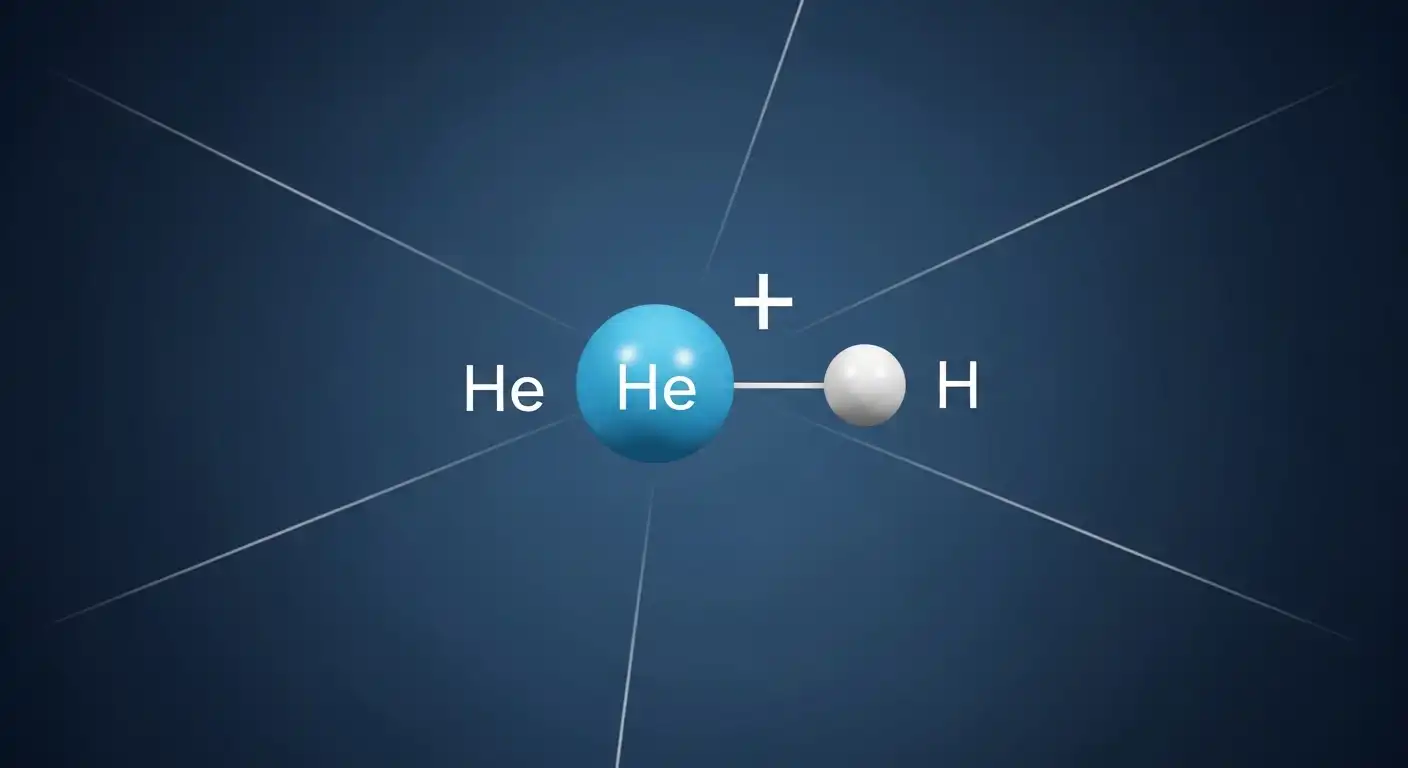
In its simplest form, the helonium definition refers to a cation formed by the combination of a helium atom and a hydrogen ion (a proton). While we often think of helium as a solo act, under high-energy conditions, it can be forced into a partnership.
The most common version is the helium hydride ion ($HeH^+$). Because helium has a completely full outer shell of electrons, it has no desire to share. However, if you strip an electron away or introduce a bare proton, the electrostatic pull is strong enough to create a temporary, yet measurable, bond.
Think of it as a molecular forced marriage. It isn’t particularly stable in a room-temperature environment on Earth, but in the vacuum of space or the high-energy chambers of a laboratory, it is a fundamental building block of chemical evolution.
Helonium Explained with a Real-World Scenario
Imagine you are operating a high-end mass spectrometer in a commercial lab. You are testing for trace impurities in a gas sample. Suddenly, you see a peak at a mass-to-charge ratio ($m/z$) of approximately 5.
Standard logic says:
-
Helium has a mass of 4.
-
Hydrogen has a mass of 1.
You might assume they are just floating near each other. But the detector is picking up a single, unified particle. This is helonium in action. In the plasma of the ion source, the intense energy has smashed a proton into a helium atom with such force that they’ve locked together.
This isn’t just a theoretical curiosity. In deep space—specifically in the planetary nebulae formed after stars die—helonium was actually the first molecule ever formed in the early universe. Without this awkward, forced bond between helium and hydrogen, the complex chemistry that eventually led to planets and life might never have started.
4 PM PT to EST: The Ultimate Time Zone Conversion Guide
How Helonium Forms: Step-by-Step Instructions
While you won’t find helonium sitting in a jar on a shelf, you can observe its formation in controlled environments. Here is how the process typically unfolds:
-
Ionization: You begin by introducing high energy—usually via an electron beam or electrical discharge—into a mixture containing helium and hydrogen.
-
Proton Stripping: The energy strips electrons away, creating free protons ($H^+$).
-
Collision: In the high-vacuum environment, these fast-moving protons collide with neutral helium atoms ($He$).
-
Bond Formation: If the collision energy is within a specific range, the proton is captured by the helium’s electron cloud, forming the $HeH^+$ ion.
-
Detection: The resulting helonium ion is then accelerated through a magnetic field where its specific mass is recorded by a detector.
This process must happen in a vacuum. If a helonium ion hits a “normal” molecule, like water vapor or oxygen, it will immediately react and break apart because it is a powerful Brønsted acid—it wants to give that proton away to almost anything else it touches.
Common Mistakes People Make
When searching for a helonium definition, many researchers and students fall into the same traps. Here are the most frequent errors:
-
Confusing it with Helium Gas: Helonium is an ion, not the stable gas you put in birthday balloons. You cannot “fill” something with helonium.
-
Assuming it is a Neutral Molecule: It carries a positive charge. If it gained an electron to become neutral, it would immediately dissociate into separate helium and hydrogen atoms.
-
Thinking it’s “Weak”: While it is unstable in our atmosphere, the bond itself is actually quite strong. It is the strongest known acid, meaning it has the highest tendency to donate a proton of any chemical species.
-
Ignoring the Environment: People often forget that helonium requires a vacuum. In a liquid or high-pressure gas, it is destroyed almost instantly.
Helonium vs. Other Noble Gas Ions
To truly understand where helonium sits in the hierarchy of chemistry, it helps to compare it to its “cousins” in the noble gas family.
| Feature | Helonium (HeH+) | Argonium (ArH+) | Neonium (NeH+) |
| Noble Gas Base | Helium | Argon | Neon |
| Stability | Lowest | Highest | Moderate |
| Acidity | Extremely High | High | Very High |
| Astrophysical Presence | Early Universe/Nebulae | Interstellar Medium | Rare |
| Mass ($m/z$) | ~5 | ~41 | ~21 |
The key takeaway: Helonium is the lightest and most reactive of the group, making it the most difficult to “catch” in a lab setting without precise equipment.
Pro Tips for Identifying Helonium in Data
If you are working in SEO-focused content creation for science or performing actual lab work, these best practices will help you handle the helonium definition with authority:
-
Check the Vacuum Levels: If your vacuum pressure is too high (meaning there are too many “normal” molecules around), any helonium peak you see is likely an artifact or “noise.“
-
Look for the Isotope: Remember that Helium-3 and Helium-4 will produce different helonium peaks. Using $^3He$ can help you confirm the identity of the ion by shifting the mass peak predictably.
-
Beware of Contaminants: A mass of 5 could also be a lithium ion in certain contexts. Always cross-reference with your sample’s known composition.
-
Focus on the Energy: If your ion source energy is too low, you won’t overcome the repulsion barrier to form the bond.
Frequently Asked Questions
Is helonium a real element?
No, helonium is not an element. It is a polyatomic ion composed of two different elements: helium and hydrogen. It does not have its own spot on the periodic table.
Can I find helonium on Earth?
You will not find it naturally occurring in our atmosphere. It only exists in high-energy environments like lightning bolts (briefly), plasma laboratories, or within mass spectrometers.
Why is helonium called the “first molecule”?
Scientists believe that after the Big Bang, as the universe cooled, helium and protons were the first things to exist. Their combination into $HeH^+$ was the very first chemical bond in the history of the cosmos.
What is the primary use of helonium?
Its primary use is in fundamental physics research and astrochemistry. It helps scientists understand how stars form and how matter behaves in the extreme cold and vacuum of space.
Is helonium dangerous?
In a lab, it is handled in such tiny quantities (individual ions) that it poses no physical danger. However, as a chemical species, it is a superacid, meaning it is incredibly corrosive at a molecular level.
The Missing Angle: Helonium as a Diagnostic Tool
Most textbooks focus on helonium as a space oddity. However, there is an angle often missed: its role in leak detection. In specialized industrial systems, the formation of noble gas hydride ions can sometimes act as a “canary in the coal mine” for hydrogen contamination in ultra-pure helium systems. If you see the helonium definition manifesting in your data during a purity test, it’s a red flag that your “pure” helium has been compromised by hydrogen.
In summary, helonium is the fascinating result of forcing the universe’s most stable element into a reactive partnership. Whether you are a student or a researcher, recognizing this ion allows you to interpret complex data that others might dismiss as an error.