
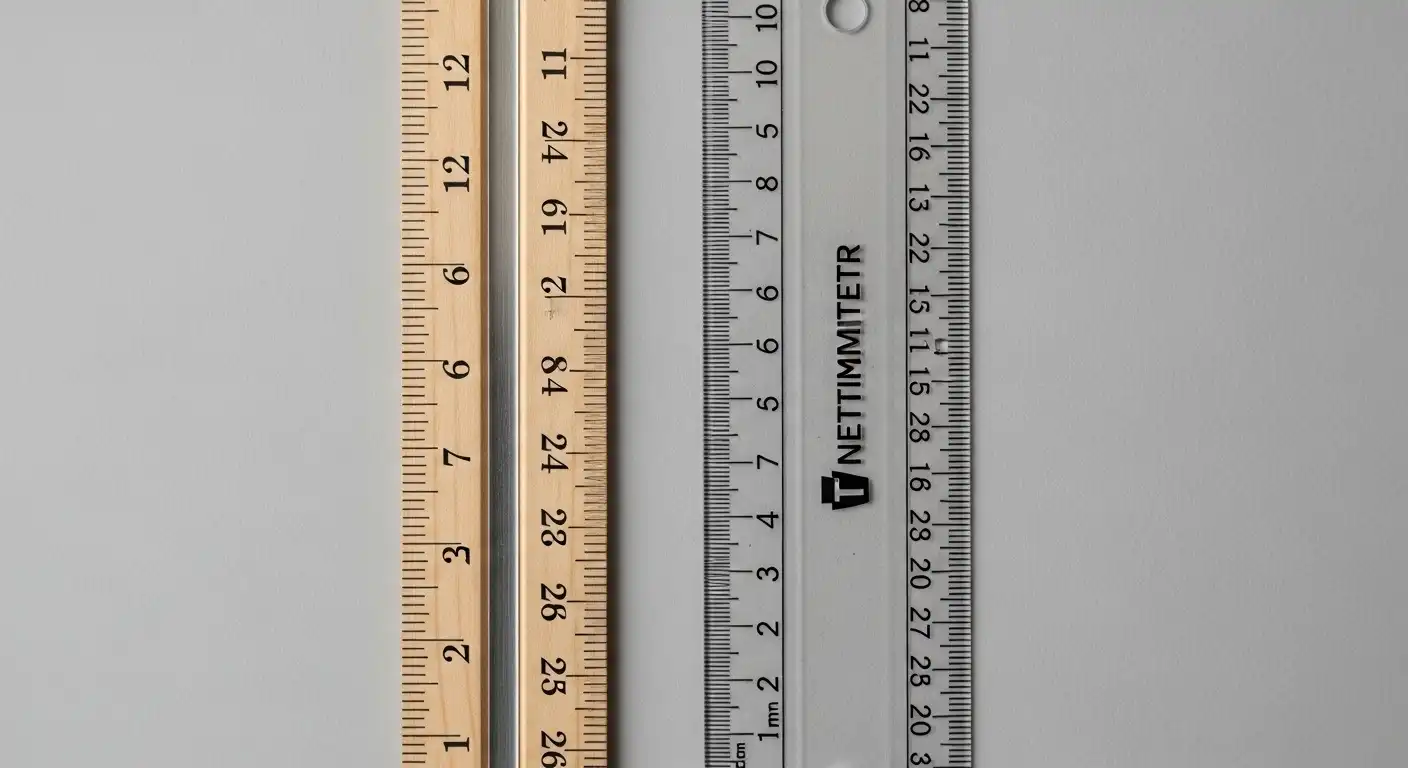

You are standing in the middle of a home improvement aisle, staring at a set of drill bits. One box says 1/4 inch, the other says 6 millimeters. You know they look almost identical, but you also know that picking the wrong one means either a loose screw or a cracked piece of wood. It’s that familiar, low-level headache that hits when your brain has to flip-flop between two different languages of size. You just want to finish your project, but instead, you’re stuck doing mental math that feels like a high school algebra pop quiz.
Whether you are a baker trying to follow a European recipe, a DIYer fixing a car with “mixed” bolts, or a student confused by physics homework, the friction between imperial vs metric is a daily reality. This isn’t just about math; it’s about the frustration of living in a world that can’t agree on how to describe a single piece of string. This guide is here to end that confusion and give you the practical shortcuts to master both systems without losing your mind.
What is Imperial vs Metric? (The Plain English Breakdown)
At its core, the difference between these two systems is how they decide to “grow.” The Metric System (officially the International System of Units or SI) is a logical, decimal-based system. Everything is built on the number 10. If you want to go from a small unit to a large one, you just move a decimal point. It’s the language of science, medicine, and roughly 95% of the world.
The Imperial System, on the other hand, is a collection of units based on historical tradition and physical objects. It uses units like inches, feet, and pounds. Unlike the metric system, it doesn’t follow a single multiplier. There are 12 inches in a foot, 3 feet in a yard, and 1,760 yards in a mile. While it feels “messy” to those raised on metric, it was designed to be easily divisible by 2, 3, and 4, which was incredibly helpful for trade and construction before calculators existed.
Imperial vs Metric Explained: The “Broken Car” Scenario
Imagine you are working on a 1990s-era truck. In that era, many manufacturers used a “split” system. You might find a 1/2-inch bolt right next to a 13mm bolt. If you try to use a 13mm wrench on a 1/2-inch bolt, it might feel like it fits—until you apply pressure and “round off” the bolt head, ruining your afternoon.
The imperial vs metric conflict here is about precision and standards. The 1/2-inch bolt is exactly 12.7mm. That 0.3mm difference seems tiny, but in the world of mechanical tension, it’s the difference between a successful repair and a stripped fastener. This scenario plays out in kitchens (milliliters vs. fluid ounces), hospitals (milligrams vs. grains), and construction sites every single day. Understanding which system you are working in isn’t just a fun fact; it’s a requirement for accuracy.
How to Switch Between Systems: A Step-by-Step Guide
If you find yourself needing to convert measurements on the fly, don’t just guess. Follow these steps to ensure you remain accurate:
-
Identify your “Base” system: Determine which system your tools or instructions are using. If you have a recipe in grams but a scale in ounces, your base is metric, and your target is imperial.
-
Use the “Golden Numbers” for quick mental math:
-
Length: 1 inch is exactly 2.54 centimeters.
-
Weight: 1 kilogram is approximately 2.2 pounds.
-
Volume: 1 liter is roughly a “generous” quart.
-
Distance: 1 kilometer is about 0.6 miles (or 5 miles is roughly 8 kilometers).
-
-
Apply the multiplier: Multiply your starting number by the conversion factor. For example, if you have 10 inches and want centimeters, $10 \times 2.54 = 25.4$ cm.
-
Check for “Reality”: Does the number look right? If you convert 100 kilograms and get 45 pounds, you divided when you should have multiplied. A kilogram is heavier than a pound, so the number of pounds should always be higher.
Orlando Magic vs Atlanta Hawks Timeline: Every Key Moment
Common Mistakes People Make
The biggest mistake is “Rounding too early.” If you are doing a multi-step calculation and you round 2.54 cm down to 2.5 cm at the very beginning, your final result could be off by several inches if you are measuring something large, like a room. Always keep the decimals until the very last step.
Another frequent error is confusing Fluid Ounces (volume) with Ounces (weight). In the imperial system, these share a name but measure different things. A cup of lead weights much more than a cup of feathers, even though they occupy the same “fluid” volume. The metric system avoids this by using grams for weight and milliliters for volume, making it much harder to mix them up.
Finally, people often assume that “Standard” always means Imperial. In many industries, “Standard” is actually Metric because that is the global standard. If you buy a “standard” set of tools in Europe or Asia, they will be metric. Always verify the specific units rather than relying on the word “standard.”
Imperial vs Metric Comparison Table
| Feature | Metric System (SI) | Imperial System |
| Base Number | 10 (Decimal) | Various (12, 3, 16, etc.) |
| Length Units | Millimeters, Centimeters, Meters, Kilometers | Inches, Feet, Yards, Miles |
| Weight Units | Grams, Kilograms, Tonnes | Ounces, Pounds, Tons |
| Volume Units | Milliliters, Liters | Fluid Ounces, Quarts, Gallons |
| Temperature | Celsius ($0^\circ$ is freezing) | Fahrenheit ($32^\circ$ is freezing) |
| Global Usage | Official in almost every country | Primarily USA, Liberia, Myanmar |
Pro Tips for Navigating the Measurement Divide
One “insider” trick used by engineers is to think in “units of ten” even when using imperial. Many high-end calipers and measuring tapes in the US actually show “decimal inches” (e.g., 1.5 inches instead of 1 1/2). This allows you to use the ease of decimal math while staying within the imperial framework.
Another tip is to standardize your workspace. If you are starting a woodworking project, pick one system and stick to it for every single cut. The moment you start mixing a metric tape measure with an imperial blueprint, you invite “translation errors” that lead to wasted material.
The most overlooked angle in the imperial vs metric debate is human scale. The imperial system persists partly because its units are “human-sized.” An inch is roughly the width of a thumb; a foot is the length of… well, a foot; a yard is a long stride. When you are estimating things by eye, imperial can often be more intuitive, whereas metric is undeniably superior for calculation and scaling.
Frequently Asked Questions
Q: Why does the US still use the imperial system?
A: It is mostly due to the massive cost of “re-tooling” an entire nation’s infrastructure. Every road sign, factory machine, and land deed would have to be changed, which would cost billions of dollars and decades of confusion.
Q: Is metric more accurate than imperial?
A: Neither system is inherently “more accurate.” Accuracy depends on the person measuring and the quality of the tool. However, the metric system is much easier to use for high-precision calculations because it avoids fractions.
Q: Can I use metric tools on imperial bolts?
A: Generally, no. While a few sizes are almost identical (like 19mm and 3/4 inch), most are different enough that you will damage the fastener or the tool.
Q: Which system is better for cooking?
A: Metric is superior for baking because measuring by weight (grams) is far more consistent than measuring by volume (cups), as ingredients like flour can be “packed” differently.
Q: How do I remember Celsius to Fahrenheit?
A: A quick “cheat code” for weather: $0^\circ$C is cold, $10^\circ$C is cool, $20^\circ$C is nice, and $30^\circ$C is hot.
Master the Measurements
The battle of imperial vs metric isn’t going away anytime soon. While the world continues to move toward a metric future, the imperial system remains deeply embedded in specific industries like aerospace, construction, and US consumer goods. By understanding the logic behind both, you